

My French Reading Revolution
How Extensive Reading Is Reshaping my French language model


“Self-selected reading is the key to language development.” — Beniko Mason
I realized a bottleneck in my French cultivation since March. I recalled dreaming in French 3 days in a row, then after that, it took a backseat with no intention of usurping my thoughts. Once I got to the 1,500-hour mark in Comprehensible Input (listening), according to my system, it was time to move on to tackle reading again.
Before 1,500-hour mark
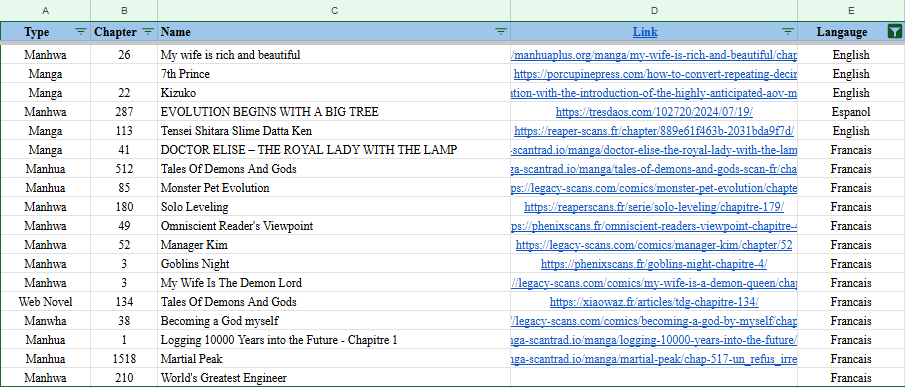
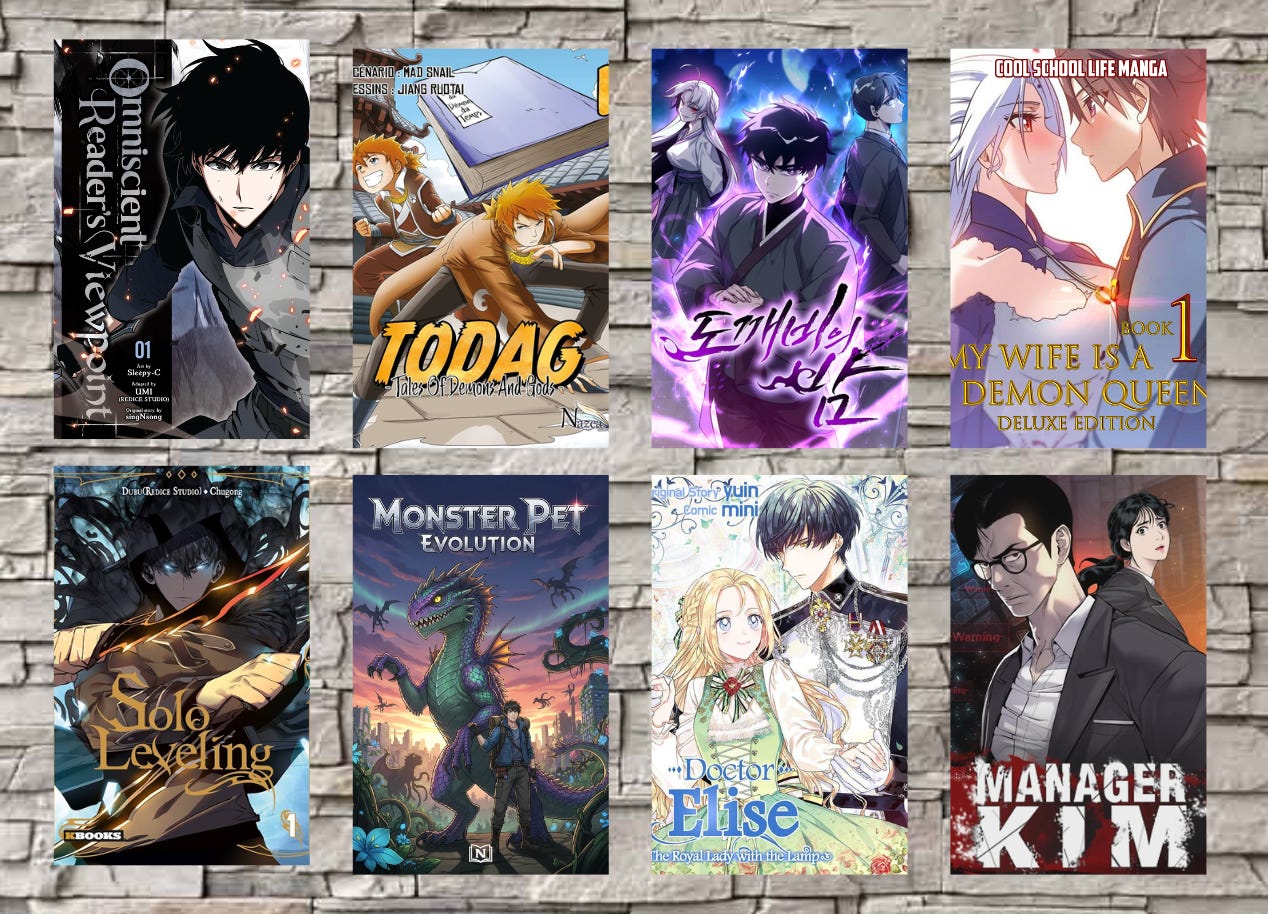
After several months of learning French, I encountered the generic advice given to language learners that they should read to improve their language. I wanted to read something that would keep my attention and thus I launched into Graphic Novels and Light novels in French along with many other pieces of print content such as new articles, documents, etc.
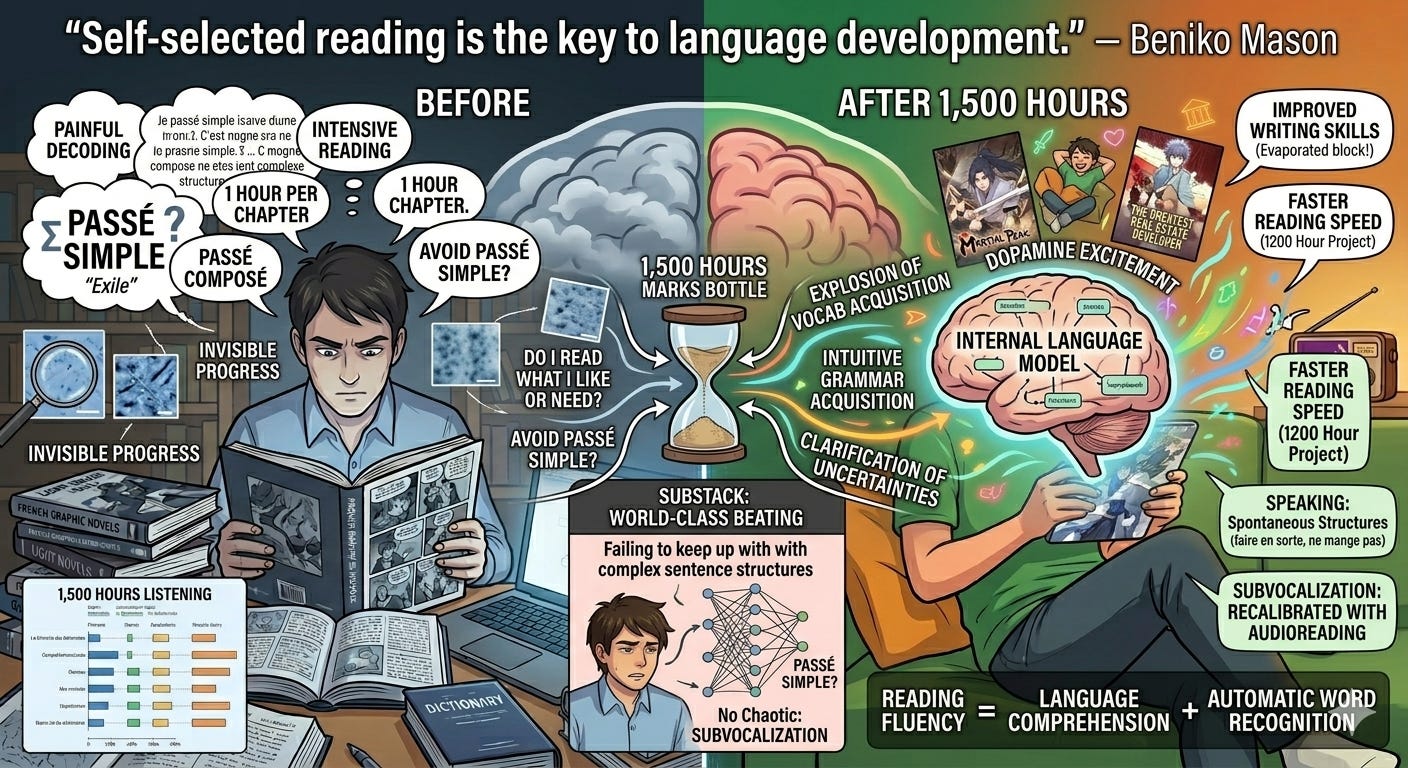
Reading was a painful process. I would often spend 30 mins to an hour on a single chapter. I spend most of my time reading intensively, looking up words and phrases, trying to put the puzzle pieces together. Constant decoding a language that I didn’t have a good command of burnt straight through my energy reserves, rendering me profoundly tired. I also tried my hands in reading a web novel in French that I had already read in English and it produced unparalleled stress with the introduction of a new tense I had no idea existed – Passé Simple et it’s equally annoying friends. I found this revolting as I was already struggling to acquire the 2 modern French Past Tenses (Passé Composé and Imparfait). This new tense introduced further chaos and eventually confused me so I had to ultimately decide its fate – Exile. I found this tense useless towards my objective as I have only seen it in literary works and since my feelings for Victor Hugo and Marcel Proust mirror that of Shakespeare, I saw no reason to attempt them.
As if playing with my meal, I slowly masticated all bits and pieces of the graphic novels I read. The sensation of reading progress cuddled me cozily and my faithful unpaid intern Google Translate needed to do less and less work. Several graphic novels later, I decided to check my speaking and writing skills. I focused a powerful microscope on my language skills to witness the improvement I was promised but they were still invisible.
Enter Substack
As my knowledge of second language acquisition grew, I discovered Substack and its audio reading functionalities, which replicate the situation of parents reading to their young kids, thus helping them in the language acquisition process. I was convinced that was my chance to broaden my vocabulary and further cultivate the language.
Diving in head first, I ended up getting a world-class beating. Many of the articles were far above my capabilities in terms of understanding complex sentence structures. I even compiled a short list of all my errors: my pronunciation was horrible; my subvocalization was inconsistent and frequently defaulted toward incorrect or English-based pronunciation patterns. I was unable many times to keep up with the audio or I would lose comprehension as my brain could not process certain sentences in time when they were complex.
Other times, I would notice that I couldn’t focus on reading and listening at the same time. It was listening followed by seeing words; however, I knew that if I had continued that, I wouldn’t have made any progress. I had to start subvocalizing each and every word synced with the audio or a few seconds before the audio to ensure my comprehension and reading speed didn’t drop. All of these issues would grow quieter with high levels of audio reading, however it remained inconsistent.
So far, I have completed 130/300 hours of audio reading and I do believe there are still a lot of benefits I have yet to discover from this method.
After 1,500 hours
After getting to the 1,500-hour mark, I had to make two choices: when am I going to consistently read and what will I be reading? Thinking about my regular digital consumption habits, I’ve decided to eliminate all competition for my attention after 7pm. Thus, reading would be my only option. Next, I decided how to approach reading itself. I had to make several choices:
Do I read novels or graphic novels/Manga?
Do I read what I like or what I need?
Do I still want to avoid the passé simple?
Despite the fact that I know that I could read novels without much of an issue, the dopamine running through my veins wanted excitement, thus I was strong armed, almost compelled I dare say, to select Manga. And in selecting Manga, I would naturally avoid Passé Simple which only left one question, the genre. The response was simple; based on my objective, I should select slice of life as that was the kind of language I wanted to acquire. However, I seemed to not like simple. The kind of excitement I needed only came from action, fantasy and comedy genres, so I found myself in the jaws of a Chinese cultivation manhua called Martial Peak (1,518 chapters) and the Korean manhwa called The Greatest Real Estate Developer (210 chapters).
This time, Reading felt different. Within 2 months I blasted through both Graphic novels, savoring every joke, every battle and every clever plot explanation and with that I realized several things.
Explosion of Vocabulary acquisition
Reading these Manga seemed to be the perfect level of input that I needed. Many of the words I could deduce their meaning (which I later realized that most times it is the figurative meanings of the words that I learnt and not the literal meanings) based on seeing them in context. I felt as if my vocabulary growth was exponential, just like during the early stages of language learning.
Intuitive Grammar Acquisition
During readings, I would encounter unmastered or partially mastered grammar points many times, and I could literally feel the sensation of acquisition happening with certain grammar points. Though I am unable to accurately describe the feeling, it is a vague sensation that my brain had started forming real understanding of the concept, even if I could not explicitly explain it.
Clarification of Uncertainties
During many listening sessions, I would encounter phrases and expressions but I could not or did not reproduce them accurately. Seeing them in written form had clarified the fuzziness I had, thus allowing greater precision.
Inaccurate Mental Prediction
My prediction model failure still persists, as I sometimes say words or complete sentences that were not on the page during reading. These predictions are also sometimes grammatically wrong. For example, I predict a wrong preposition such as “de” instead of “à”. Although the inaccurate prediction persists, I have seen it less frequently, which I would argue is not only due to reading.
Other effects on my language development
Improved Writing skills
Generally, when writing advanced level pieces, I always tend to feel a cognitive block for the first 2 days. After starting extensive reading, that writing block evaporated into thin air and I was able to write more freely with much more flexibility and accuracy than before. As more and better adverbs, expressions and idioms emerge in my writings, I feel like I am able to express my style of writing now.
Reading speed
My reading speed would usually start off slow each day and then within a few chapters, the pace would increase considerably. However, I also saw that my brain would skip over common words as the printed meaning would already be interpreted automatically.
Speaking
I saw a few of the new structures, words and expressions from my readings showing up in my spontaneous speaking sessions as they just “felt right” to say. For example, the expression faire en sorte (to make sure) and the reintroduction of “ne” in my sentences for negation, for example je ne mange pas instead of je mange pas.
Sub vocalization
My sub vocalized pronunciations seem to tend toward default English pronunciation after prolonged sessions of silent reading and thus needed to be recalibrated from time to time with the aid of AudioReading. In addition, I noticed that my verbalized pronunciation in French was more accurate than my subvocalized pronunciation.
In stating my observations, it would be considered a disservice if I led my audience down the wrong alley by not adding more context. As a child reads, speaking, listening and writing does not stop, and this was naturally the case for me. In attempting to simulate a natural environment as much as possible, I was still having short conversations via call and text and I still use France Culture Radio in the morning for 30 minutes. So these naturally would have also contributed to my development.
From research, I was already well aware of the changes to expect in my internal language model, however that did not lessen the exhilarating sensation of this new found progress. The Reading Symphony had taught me that the formula for Reading Fluency is:
Reading Fluency = Language comprehension + Automatic word recognition
So I knew that once I had a sufficient level of comprehension, my reading skills would improve naturally. Currently I have done over 100/1,200 hours of my estimated 3.5-year Extensive Reading project in French. My impatience grows by the second as I await the profound evolution of this language towards linguistic precision and the development of a more concrete writing style.
While Spanish buzzes around like a busy 2-year-old with nothing better to do, French seems to be a pro at hide and seek in my mind. However now it doesn’t feel as if it’s decaying, instead, it feels contained.
Thank you for Reading!
You can see some of latest article here:


One day, I'll do this. Since I like biology, is reading primary school biology textbooks in French okay?
Nous voulons la tête du roi !