

Polyglot in Progress #14: Entering a New Phase of Language Cultivation
Polyglot in Progress Issue #14 — May 2026

Life is a series of natural and spontaneous changes. Don’t resist them; that only creates sorrow.” — Lao Tzu
Overview
This (2) two months’ report captures a period of transition. While Spanish continued to become more familiar through daily exposure and emotional engagement, French took an unexpected turn as extensive reading accelerated vocabulary growth and brought new patterns into focus.
At the same time, reduced attention to German, Portuguese, and several other languages made their absence increasingly noticeable. Together, these observations suggest that the languages are beginning to evolve in different directions, as if each is gradually settling into a new role within the cultivation system.
Early Teenage Languages (French, Spanish)
Spanish:
Observation Summary:
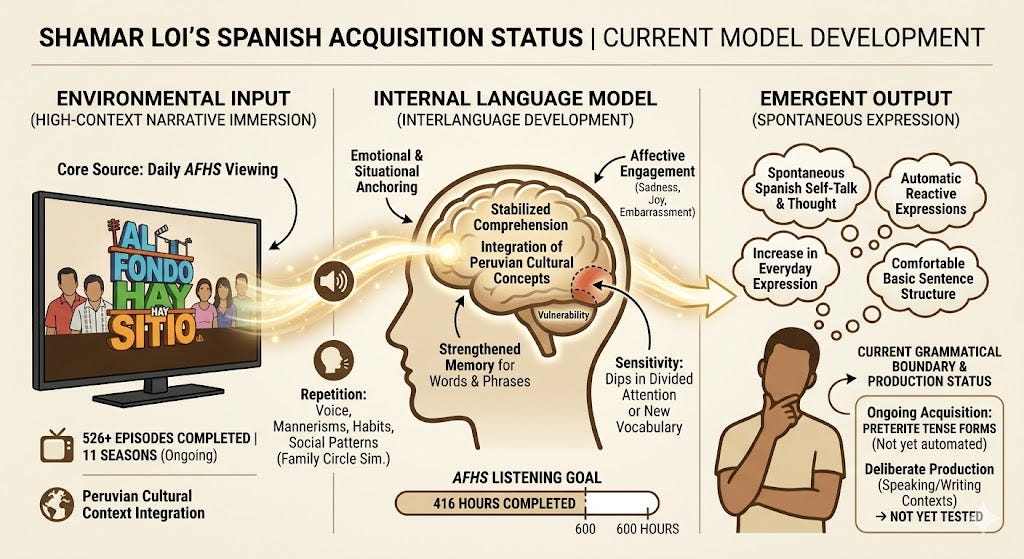
I continued my daily viewing of Al Fondo Hay Sitio, where comprehension remains generally stable and strongly influenced by emotional engagement. The series consistently produces strong emotional responses (sadness, joy, embarrassment, etc.), which makes the series highly engaging. There are still occasional dips in comprehension when attention is divided or when new vocabulary appears.
I also noticed an increase in Spanish use in everyday self-talk and active expression. While I can comfortably produce basic sentences, Preterite forms are still acquired. I also have not yet deliberately pushed Spanish into production contexts to test its limits.
Analysis:
The emotional content of the series is strengthening memory for words and phrases, making the language feel more natural over time. Repeated exposure to similar emotional situations is also leading to certain Spanish expressions becoming automatic reactions in my mind, which explains why more Spanish is appearing in self-talk.
Data:
70 hours total comprehensible input over April-May
416 hours total comprehensible input
source: Al Fondo Hay Sitio 526 episodes
Thoughts:
I’ve decided to stick with this series as my main input all the way through to 600 hours. The idea comes from how, in a family, a child is exposed to a small number of people over and over again and gradually becomes familiar with their voices, mannerisms, habits and small social patterns. Al Fondo Hay Sitio creates a similar environment through its long 11-season structure, where the same characters and relationships are reinforced over time. It also gives cultural context on Peruvian society.

Result:
Spanish is becoming tied to family life and everyday situations through repeated exposure to a long-running series, making it feel more familiar and easier to use in spontaneous thought and self-talk.
French:
Observation Summary:
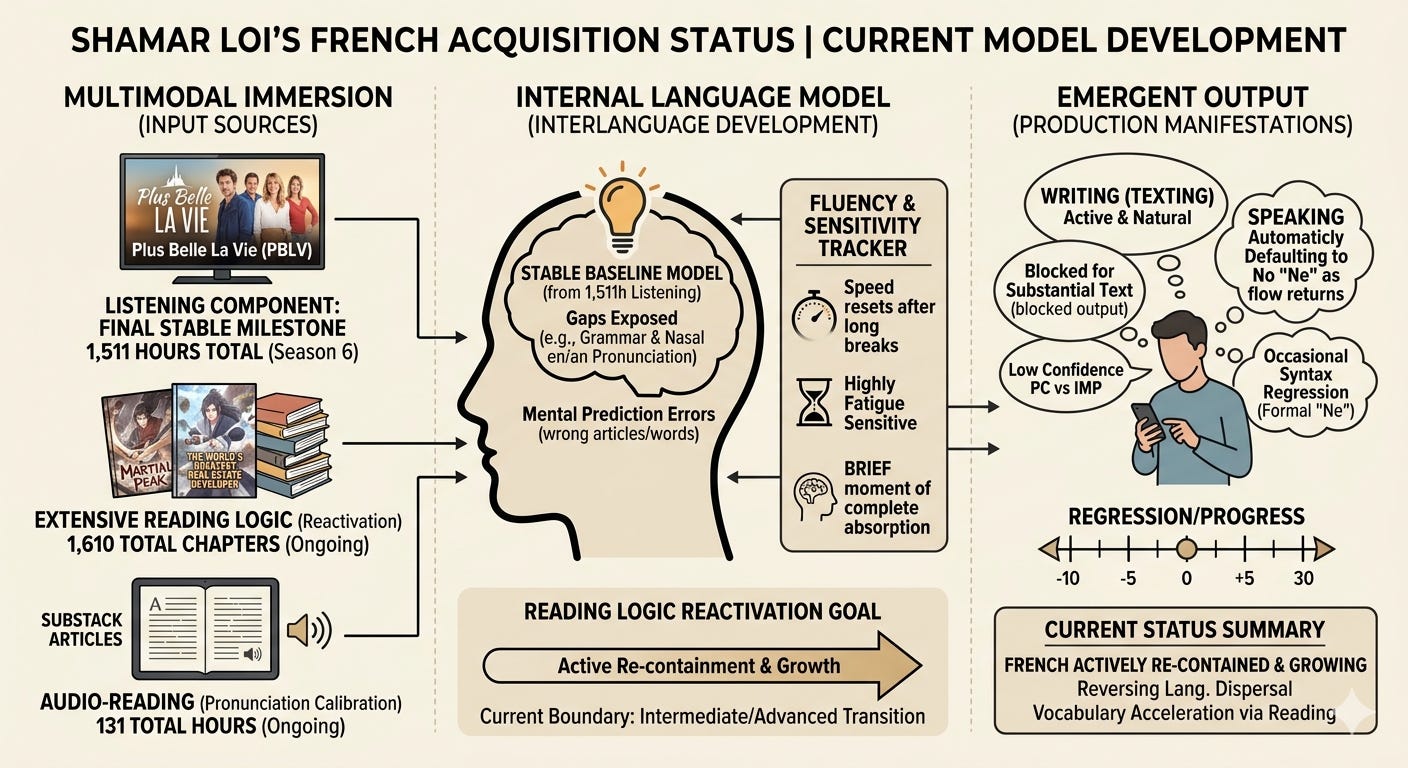
Listening comprehension remains strong and largely stable as it has reached it’s final milestone (1500 hours).
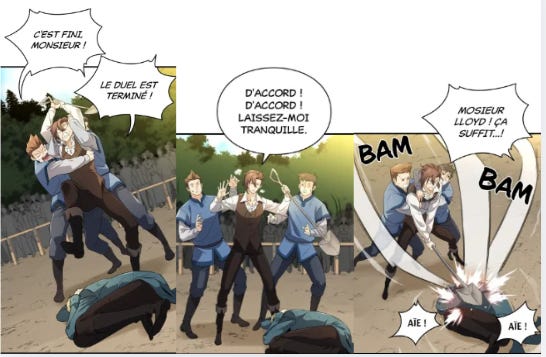
Extensive reading began with Martial Peak, where I was quickly reminded of many grammar structures that I still cannot produce naturally. During the first several days, reading fluency declined as these forms became visible again, though repeated exposure gradually made many of them feel more familiar. I also noticed prediction errors while reading, where my brain would substitute the wrong article or even words that were not on the page. When I switched to a different manga, my reading speed immediately dropped, suggesting I had become adapted to the author’s style.
During the second week, I realized that my internal pronunciation was deteriorating, so I supplemented my reading with audio-readings of Substack articles to help guide my internal model. Reading performance also proved highly sensitive to fatigue and interruptions. Sessions often began slowly before accelerating, while long breaks could reset my reading speed entirely.
By the third week, I noticed that I was sometimes looking at words without actually saying them in my mind, which reduced comprehension. To compensate, I became more deliberate in mentally pronouncing each word, even though this slowed reading speed. By the end of the month, however, I was acquiring new vocabulary at an impressive rate and regularly encountering new words and pronunciations worth looking up.
In May, I still found myself re-reading dialogue to avoid skipping words, but reading generally felt easier and less effortful once I settled into a session. I later began The Greatest Real Estate Developer, which felt easier to read overall, though my mental prediction model continued to make occasional mistakes. I also experienced several brief moments where I became completely absorbed in the story and forgot I was reading French at all. While these moments were short-lived, they felt like a glimpse of a different level of reading fluency.

Audio-reading exposed pronunciation errors that I thought to have been corrected long ago, particularly with nasal sounds such as en and an. For a brief period, these sounds became highly noticeable, making it feel as though my internal pronunciation had regressed again. As exposure continued, the sounds stopped feeling novel and gradually returned to normal. A later challenge was maintaining comprehension as I often found myself unable to keep pace with the narration, causing comprehension to drop.
Writing, even though I generally text my friends in French every day, I felt blocked when I had to write anything more substantial. This feeling seems to reoccur whenever I take a break from writing. While writing, I noticed several words and expressions acquired during my reading sessions beginning to appear naturally in my output. However, my confidence in selecting between the passé composé and imparfait seemed far weaker than expected, as if my understanding had never fully solidified. Despite these difficulties, writing felt easier than it had before I resumed extensive reading.
Speaking, during brief conversation sessions, I noticed myself adding the ne in negative sentences again. However, as the conversation became more natural, I automatically returned to dropping the ne, as this felt more natural and effortless.
Analysis:
The large volume of extensive reading appears to have reactivated French in a way that listening alone was no longer doing. As reading volume increased, previously unnoticed gaps in acquisition became more visible, while repeated exposure gradually strengthened familiarity with many of these forms. The improvement in reading speed, vocabulary growth, and transfer of words and expressions into writing suggest that French is becoming more active and accessible again. Overall, reading appears to be helping normalize French in the mind again, reversing the sense that the language had been slowly dispersing over the previous months.
Data:
1500 hours total Comprehensible input
26 hours CI Input for 2 months (April-May)
Plus Belle La Vie series - Season 6 completed
Manhua: Extensive Reading Martial Peak 1518 chapitres (75hours)
Manwha: World’s Greatest Real Estate Developer (92 chapters) (8hours)
Audioreading (audio+text): 131 hours of Substack articles.
Audioreading: 6 hours of Substack articles these two months
Thoughts:
Since February, French has felt different. It no longer seemed to buzz in my brain the way it once did, and I felt that a silent French was a problem. Only now do I realize that I probably needed a change in approach. Since starting to read extensively again, I felt like my French, which had been slowly dispersing despite continued listening, was now being contained and growing again. What has surprised me most is the rate at which I am picking up new vocabulary. It feels similar to earlier stages of language learning, where new words appear frequently and are acquired quickly. I am now waiting to see how this will affect my speaking in a meaningful way.
Result:
French reading is strengthening and reactivating the internal language model, making vocabulary and grammar more accessible again.
Other Languages (Slovene, Mandarin, Japanese, Telugu, Polish, Portuguese, German)
German feels less accessible again, and words that used to be familiar now take more effort to recall. While playing Final Fantasy Tactics Advance, reading feels noticeably harder, as I often have to search for meanings I previously knew
Portuguese reading is still slightly difficult and mostly depends on similarities with Spanish to understand meaning.
Data:
Portuguese: Auto Skill de Ore dake Chousoku Level Up (Chapter 3)
German: Final Fantasy Tactics Advance (1hr 42 mins)
Slovene, Mandarin, Japanese, Telugu, Polish: no active input
Thoughts:
Other languages have been inactive or reduced in input over this period in order to focus on French and Spanish for a few months. I do however feel like I miss my languages, especially German and Mandarin.

Miscellaneous Observations
Several smaller observations emerged that are worth documenting.
One Saturday, I intentionally thought in French for 8 hours and as a result I was was profoundly tired and unable to do any other languages.
Another time, I fell asleep while trying to read Martial Peak manhua in French and I somehow continued reading in my dream.
I interestingly found out that I am able to do activities in other languages outside of English while listening to Spanish. So far I am about to read paragraphs in French and play games in German during a Spanish Listening session and still follow the story.
During reading, I noticed that my internal pronunciation is sometimes incorrect compared to when I speak aloud, where pronunciation feels more accurate.
Final Thoughts
It is my belief that both my languages, French and Spanish, are at the point of evolution; however, they lack sufficient work to push them to the next level. So, for the following month, I will try to do more to force my overall ability in French to improve, and hopefully the same for Spanish by the end of the year, with massive reading and output opportunities.
I leave you with this beautiful song by Maricarmen Marin — Feliz Contigo
Cuando yo te vi, por primera vez
Jure que solo tú serias mio
Y fue asi, cuando me acerqué, para poder bailar contigo
Mi corazón, latía diferente
Y yo en medio de tanta gente
¡Oh no!
Que pensaran mis amigos
Pero lo que busco, lo consigo
Ahora solo quiero bailar
Y decirle al mundo que te voy a amar
Solamente quiero ser feliz contigo
Solamente contigo!— Lyrics of Feliz Contigo by Maricarmen Marin
Thank you for reading!
References
Bjork, R. A., & Bjork, E. L. (1992). A new theory of disuse and an old theory of stimulus fluctuation. In A. F. Healy, S. M. Kosslyn, & R. M. Shiffrin (Eds.), From learning processes to cognitive processes: Essays in honor of William K. Estes (Vol. 2, pp. 35–67). Lawrence Erlbaum Associates.
Day, R. R., & Bamford, J. (1998). Extensive reading in the second language classroom. Cambridge University Press.
Ellis, N. C. (2002). Frequency effects in language processing: A review with implications for theories of implicit and explicit language acquisition. Studies in Second Language Acquisition, 24(2), 143–188. https://doi.org/10.1017/S0272263102002024
Krashen, S. D. (2004). The power of reading: Insights from the research (2nd ed.). Libraries Unlimited.
Nation, I. S. P. (2014). How vocabulary is learned. TESOL Press.