

Designing a Reliable Language Acquisition System
The Language System (Part 1): Building a system that respects acquisition

Welcome To 2026 My Friends!
Sometime in 2025, I came up with the goal of dedicating 10 years to actively acquire languages. I wanted to put an end to this long, overbearing desire to speak and/or understand certain languages. Since I started in 2024, this marks the beginning of my third year of actively acquiring languages.
Over these last 24 months, I have hours reading, researching and experimenting on a wide range of things within the realm of Language Learning & acquisition, Cognitive Studies & Psycholinguistics. Why?
I wanted to know what actually works, how they work and why.
Mistakes With French
After two years of learning French, I have committed many sins against this language. However, my biggest sin was that I did not allow my interlanguage to stabilize correctly.
Interlanguage is the temporary, evolving version of a language that exists in our head while we’re learning it.
I powered through French grammar in little over one month because I wanted to get speaking as quickly as possible. I spent only a few hours practicing pronunciation. I thought that once I could perform a skill with relative ease, I no longer needed to study it anymore. How presumptuous I was!. This led to massive and often frustrating fluctuations of language ability. This is thoroughly highlighted by Talita Souza, who states:
“Reaching a consolidated C1 level requires: Sustained, high-quality input, long-term stabilization of interlanguage, reduced affective filters and Time.” - Talita Souza, article: Setting realistic goals in language learning
Thus I have zero intention of overestimating my linguistic capacities moving forward.
The Need For A System
Being an engineer by training. I like systems. I like seeing them, designing them and examining them. In language learning, there are so many things to consider: what to do? When should we do it? How long should we do it?
If there is no clear path, then our language acquisition process risks becoming ineffective and eventually leads to frustration. Therefore I want to build a system where I won’t need to think about the next step. Each step should naturally follow the previous one in a logical and consistent way.
There are also things I want to avoid as much as possible, including a bad accent, pronunciation issues, negative transfer from my first language, and lingering grammar problems.
Start From First Principles
The human animal has been learning languages for thousands of years, yet we still argue about what works. Languages are learnt through meaningful input. Every single person learned their first language or languages through the long, slow process of listening to comprehensible input. With the availability of so much content for language learners, getting comprehensible input has become much easier to do. However, just as with native speakers, there are limitations to this approach. Roldano De Persio outlined this perfectly:
“…You can absolutely become conversational through exposure alone. I’ve seen videos of immigrants who learned Italian or German perfectly fluent, complete with regional accents and hand gestures…. But what people often don’t mention is that these speakers usually have a limited vocabulary and weaker grammar.“ - Roldano, The neuroscience behind why paper still wins
Since we can acquire conversational fluency through comprehensible input alone, this should undoubtedly be the backbone of any language learning strategy. Thus, the backbone of my system. Using Dreaming Spanish’s roadmap as a guide for required listening hours (1500hrs).
Note: Whenever I mention comprehensible input, I am referring only to listening input, whether audio-only or audiovisual.
Additional Language Development Activities
“When you align your learning with how your brain actually processes language, everything changes. Patterns emerge faster. Retention improves dramatically. Speaking becomes natural instead of terrifying.” - Chiara Languagefreak, Your brain is wired to acquire language efficiently.
Structuring language development activities must align with how the brain works and must also be done at the right time. Going against this naturally leads to deep frustration and even resentment.
After consulting some of the best advice, including Roldano’s A Practical Guide to Learning a Language Effectively and Christina’s piece What to Prioritize at Every Stage of Language Learning, along with my own readings and experience. I have concluded that these are the additional activities I will incorporate alongside comprehensible input:
Language Priming → Pronunciation (and Orthography) → Grammar Study → Audio-Reading → Copywork / Journaling → Mass Sentence Method → Shadowing → Ouput + Extensive Reading
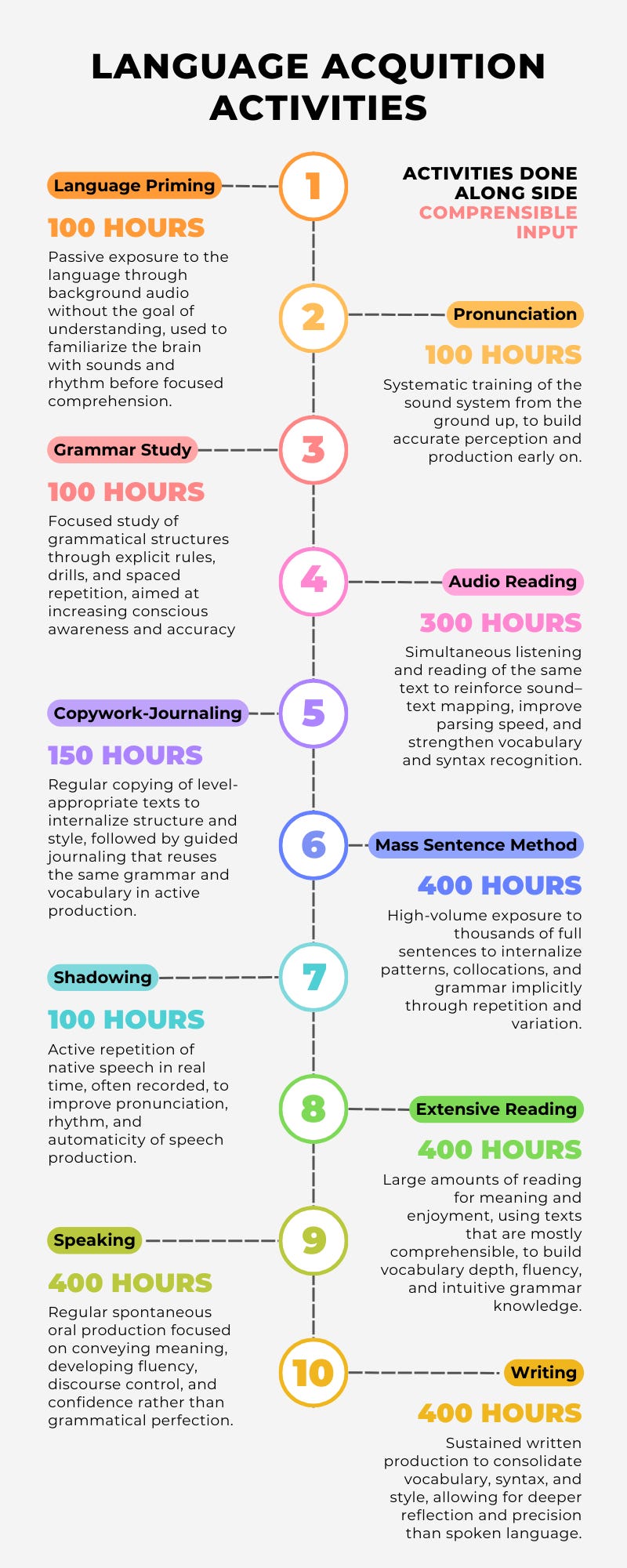
Note: The hours provided are preliminary and will change depending on the language. Also some activities may overlap.
This structure aligns, for the most part, with how skill acquisition and development work in language learning. Each phase removes a specific constraint before the next is introduced, meaning nothing is asked of the system before it is capable of supporting it. As a result, the barriers that previously distorted my acquisition process, unstable pronunciation, premature output, weak grammatical consolidation, and fluctuating performance, are handled upstream. Interlanguage is given time to settle. Skills emerge only after their foundations are already in place. Instead of constantly correcting errors after they appear, the system prevents most of them from forming in the first place.
Life is an experiment, and so is language learning for me. I wish you all the best in your own language learning journey.
Thank you for Reading!
You can see some of latest article here:


Thank you so much for the mention. I truly appreciate it!
I really enjoyed reading your reflection and admire how thoughtfully you are approaching the learning process.
The system and planning you describe are solid, realistic, and exactly what supports long-term growth. Keep going. :)
Hi Shamar! Thanks for the mention. This is really interesting and I especially appreciate your honest reflections about what's working for you and where you feel you've gone wrong in the past. There's no doubt that this system will support your learning. 💪🏻
I love the activities you've recommended. I'm curious to learn more about how you allocated the number of hours per activity. I'd also love to hear more about the mass sentence method, which is new to me!
Keep sharing, please. 😊